Pufferfish
Winter in SokchoPufferfish occupy an uneasy place between lethal danger and culinary artistry. Their organs contain toxins, yet their translucent flesh can be transformed by a skilled cook into a dish meant to dazzle. In the narrator’s family, that transformation belongs first to her mother, the only fishmonger in Sokcho licensed to prepare them. When the narrator later handles one herself, the fish becomes the focus of an exacting imitation: she attempts a procedure she was never permitted to perform, and makes a fragile platter that she would like her mother to see.
Skill, Danger, and Family Knowledge
The mother’s authority is practical as well as ceremonial. She serves Pufferfish when she wants to impress guests, and she knows that removing the poisonous organs requires control: a knife must not pierce the intestines, ovaries, or liver. The daughter watches her work, but watching has not amounted to instruction or permission. Her mother has never allowed her to handle Fugu. The boundary makes expertise something the daughter can observe closely but cannot inherit by simple proximity.
At the Seollal gathering, the dish also exposes competing ideas about who can be trusted to prepare it. The narrator’s aunt, visiting from Seoul, delights in the Pufferfish sashimi but says she does not eat it there because she distrusts the Japanese chefs who claim to be licensed. She invokes the danger of the flesh, claiming that twenty grams could asphyxiate a man, and gives her suspicion an explicitly nationalistic edge. Her enjoyment of the dish sits beside that distrust. She praises the prized food while turning her attention to the grayish octopus dish, where the narrator has pierced its ink sac. The meal brings culinary pride, fear of poisoning, and family criticism to the same table.
The Daughter’s Attempt
Before dawn, the narrator goes through the unloading area of the fish market, where Pufferfish float open-mouthed in tanks. Her mother has removed their teeth so they cannot hurt one another. The narrator chooses the fish she thinks looks most stupid, telling herself her conscience is clear. But when she lifts it from the water and it beats violently with its fins, she panics and hits it too hard, smashing its head with her fingers. She puts it in a bag to keep the head from leaking on the way to the guest house. The first act of her preparation is not graceful mastery but a frightened, forceful encounter with a living animal.
At the guest house, she tries to approach the work as her mother would. She pictures her mother’s method and tells herself the fish must be prepared perfectly. The preparation demands decisions that cannot be undone: she cuts off the fins, struggles with the unexpectedly thick cartilage, and uses a heavier knife to remove the head. After opening the skin and exposing the viscera, she finds that the fish is male and has no ovaries. Using her fingers to avoid puncturing the organs, she removes the intestines, heart, and stomach, then carefully frees the small pink liver from its attachment to the gall bladder. She seals the liver in a bag and throws it away.
The sequence makes the danger concrete through touch and procedure rather than explanation alone. The organs must be handled without being pierced; the fish’s skin feels gritty, its cartilage resists the knife, and its viscera slide free under the narrator’s fingers. She washes the fish, cuts it into sections, and checks the fragile white fillets for traces of blood. Then she slices them with her finest blade, whose tip vibrates slightly. An hour after beginning, she has finished. The duration and minute precautions distinguish this work from an effortless display of inherited skill.
Presentation and Meaning
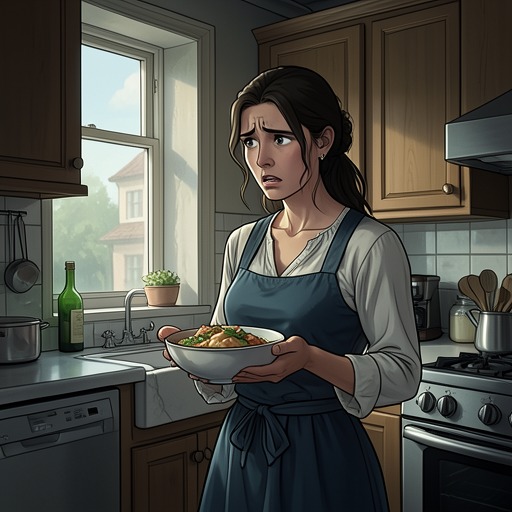
The narrator completes the dish with grated radish and a dressing of rice vinegar and soy sauce. She arranges the slices on a large ceramic platter decorated with mother-of-pearl cranes. The Pufferfish is so delicate and feathery that the decoration remains visible through it; the arrangement makes translucence part of the presentation, not merely a property of the flesh. The narrator would like to show the result to her mother, whose expertise shaped the attempt even though the daughter had to carry it out without her guidance.
Cooking also differs from the artistic process the narrator observes in Yan Kerrand. She tends to begin with the finished dish in mind, considering its appearance, taste, and nutritional balance. Kerrand, by contrast, seems to give himself over to the movement of his hand as an image takes shape. The narrator’s Pufferfish preparation brings that contrast into the kitchen: it is guided by a clear ideal of perfection, yet the living fish, resistant materials, and delicate cuts make control uncertain at every stage. The finished platter is at once a display of care and evidence of how precarious that control has been.
After carrying the platter into the alley, the narrator pauses to stroke a kitten. It follows her for several metres, mewling and pointing its nose toward the fish. The scene ends before the kitten reaches or eats it. Its attention leaves the carefully arranged, nearly insubstantial slices exposed to the ordinary appetites of another creature, a final contrast between the dish’s fragile beauty and the danger carried by its substance.